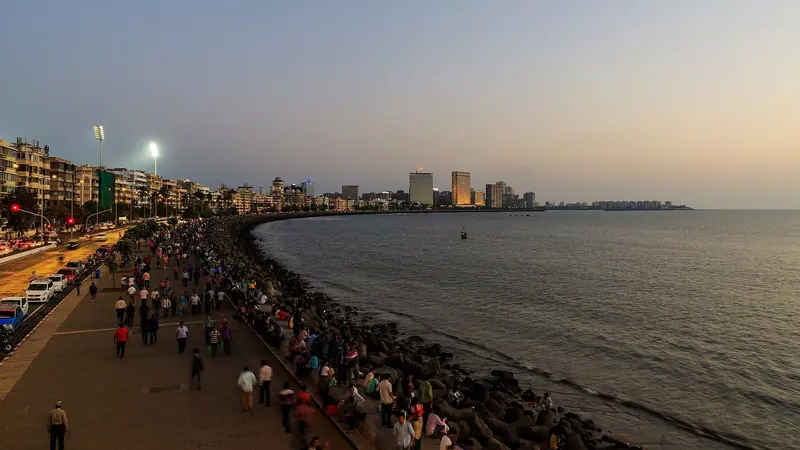
An evening walk on Marine DrivePhoto: A.Savin, FAL
Geography
02 The seven regions of IndiaNorth · South · East · West · Central · North-East · Islands
A Country of Regions
One nation, seven worlds.
India is best understood not as a single country but as seven distinct cultural geographies, each with its own language families, food traditions, climate, dress, music and temperament. Knowing your region transforms how you experience the assignment.
The seven regions at a glance
A working geography, the political map of India showing all 28 states and 8 union territories. The legend on the right groups them into the seven cultural-economic regions an international family will hear referenced again and again.
Seven cultural-economic regions
A working mental model your IKAN consultant will reference repeatedly. The map's colours just separate adjacent states for legibility, they don't match these regions.
Karnataka, Tamil Nadu, Kerala, Andhra Pradesh, Telangana
IS
Islands
Andaman & Nicobar, Lakshadweep
The Deccan Plateau is a geographic landform (not a region) sitting across the central-south band, Bengaluru and Hyderabad both sit on its edge.
North India
The Hindi heartland
Delhi, the Ganges plain and the Himalayan crown. Hearty wheat cuisine, hot summers and cold winters. The political, cultural and language centre of Hindi India.
DelhiPunjabHaryanaUPRajasthanHPUttarakhandJ&K
South India
The Dravidian south
Tropical, temple-rich, technology-led. Rice and coconut cuisine, classical music and dance, filter coffee, and India's two leading tech corridors, Bengaluru and Hyderabad.
Kolkata's intellectual swagger, Odisha's temple coastline, mustard-fish-rice traditions, and the literary and artistic heart of modern India. Durga Puja capital of the world.
West BengalOdishaBiharJharkhand
West India
The commercial coast
Mumbai's hustle, Gujarat's enterprise, Goa's beaches. India's industrial and financial engine, with sea-facing cities and the largest expat communities outside Delhi-NCR.
MaharashtraGujaratGoaD&NH-Daman
Central India
The tiger belt
India's wild heart: Kanha, Bandhavgarh and Pench national parks; the marble temples of Khajuraho; tribal cultures preserved across forested plateaus. Increasingly a manufacturing destination.
Madhya PradeshChhattisgarh
North-East India
The seven sisters
Seven states tucked between Bhutan, China, Myanmar and Bangladesh, tribal cultures, tea plantations, the highest rainfall on earth (Cherrapunji) and India's most distinctive cuisines.
Two distinct island chains, the Andaman & Nicobar group in the Bay of Bengal and the Lakshadweep atolls off the Kerala coast. Beaches, coral reefs, distinct tribal cultures, and India's south-easternmost reach.
Andaman & NicobarLakshadweep
🏔️Five great landforms
Himalayas
The northern wall, nine of the world's ten highest peaks lie along India's borders.
Indo-Gangetic Plain
The fertile river belt feeding an estimated 600 million people; home to Delhi, Lucknow, Patna, Kolkata.
Thar Desert
India's arid west, Rajasthan's golden cities (Jaisalmer, Jodhpur) and the Rann of Kutch.
Deccan Plateau
The volcanic tableland of southern India, Bengaluru, Hyderabad, Pune sit on its edges.
Coastal & Islands
7,500 km of coastline, plus the Andaman, Nicobar and Lakshadweep archipelagos.
🌊The waters that shape India
Ganga (Ganges)
2,525 km, sacred mother-river of Hindu civilisation, flowing east to the Bay of Bengal.
Brahmaputra
One of the world's largest by volume, the lifeline of Assam and the north-east.
Indus
Cradle of the 5,000-year-old Indus Valley civilisation; flows mostly through Pakistan today.
Yamuna
The river of Delhi and Agra, the Taj Mahal stands on its banks.
Godavari & Krishna
Southern India's great rivers, feeding the rice bowls of Andhra and Telangana.
🧭
The 'four India' mental model: Most international families find it useful to think of India in four practical zones, North (Delhi-NCR, Hindi, government, hearty cuisine), South (Bengaluru, Chennai, Hyderabad, tech, Dravidian languages, milder climate), West (Mumbai, Ahmedabad, commerce, Marathi/Gujarati) and East (Kolkata, the north-east, Bengali, arts, tea). Most expat assignments land in the first three.
Society
03 People, language & religion22 scheduled languages · 9 major faiths · 4,000+ ethnic communities
The Indian Mosaic
A young, urbanising, strikingly diverse nation.
India's population is its most extraordinary feature, younger than any other large economy, growing fastest in cities, and spread across more languages, faiths and ethnicities than any other country on earth.
28
Median Age (years)
Vs. China 39, USA 38, Japan 49
36%
Urban Population
520M+ city-dwellers
~77.7%
Literacy Rate
English literacy ~12% (largest after US)
~12%
English Speakers
~150M · world's 2nd largest
Languages · the twenty-two
India's Constitution recognises 22 scheduled languages, but more than 120 languages and 270+ mother tongues are spoken daily. Hindi and English are both official languages of the Union government; English remains the language of higher education, business, the judiciary and inter-state communication.
Hindi
हिन्दी
North · 528M speakers
Bengali
বাংলা
East · 97M speakers
Marathi
मराठी
Mumbai/Pune · 83M
Telugu
తెలుగు
Hyderabad · 81M
Tamil
தமிழ்
Chennai · 75M · classical
Gujarati
ગુજરાતી
Gujarat · 55M
Urdu
اُردُو
North · 51M
Kannada
ಕನ್ನಡ
Bengaluru · 44M
Odia
ଓଡ଼ିଆ
Odisha · 38M · classical
Malayalam
മലയാളം
Kerala · 35M · classical
Punjabi
ਪੰਜਾਬੀ
Punjab · 33M
Assamese
অসমীয়া
Assam · 15M
Maithili
मैथिली
Bihar · 13M
Sanskrit
संस्कृतम्
Classical · liturgical
Konkani
कोंकणी
Goa · coast
Nepali · Manipuri · Dogri · Bodo · Santali · Kashmiri · Sindhi
+ 7 more
Regional & tribal
💡
The English advantage: Every metropolitan area, airports, hotels, hospitals, schools, restaurants, offices and gated residential communities, functions in English. You can live and work in India for years without learning a local language. That said, ten words of Hindi (or your city's regional tongue) earn disproportionate goodwill: drivers smile wider, vendors quote fairer prices, and meetings warm faster.
Religions of India
India is the birthplace of four major world religions (Hinduism, Buddhism, Jainism, Sikhism) and a thousand-year home to four more (Islam, Christianity, Judaism, Zoroastrianism). Religious life is openly visible in daily India, in dress, food, festivals, architecture and public holidays. The population shares shown below reflect 2011 Census proportions applied to today's population, indicative.
🕉️
Hinduism
~79.8% · ~1.15B
World's oldest living religion. No single founder; tradition speaks of 33 koti devatas (here koti means 'type/class', not literally 330 million gods). Defines daily ritual, festivals and architecture across India.
☪️
Islam
~14.2% · ~204M
India is home to the world's third-largest Muslim population. Strongest in Hyderabad, Lucknow, Mumbai, Kashmir, Kerala.
✝️
Christianity
~2.3% · ~33M
By tradition, it arrived in Kerala around 52 CE with St Thomas. Largest communities in Kerala, Goa, the North-East, Tamil Nadu.
🪯
Sikhism
~1.7% · ~25M
Founded 15th-century Punjab. Concentrated in Punjab, Delhi, Haryana. Recognised by the turban and uncut hair.
☸️
Buddhism
~0.7% · ~10M
Born in India under the Bodhi tree in Bodh Gaya. Today strongest in Ladakh, Sikkim, Arunachal & among Dalit communities.
🪔
Jainism
~0.4% · ~5M
Strict non-violence, vegetarianism (often no root vegetables). Hugely influential in business across Gujarat, Rajasthan, Mumbai.
🔥
Zoroastrian
~50,000 (Parsi, declining)
Persian refugees who arrived in Gujarat 1,300 years ago. Tiny community of disproportionate influence in Mumbai industry.
✡️
Judaism & Bahá'í
Historic minorities
Cochin, Bene-Israel and Baghdadi Jewish communities along the west coast. The Lotus Temple in Delhi is one of the world's most visited Bahá'í Houses of Worship.
🙏
Religious respect at a glance: Remove shoes before entering any place of worship or Indian home. Cover head and shoulders at Sikh, Muslim and many Hindu/Jain sites. Photograph deities only after asking. Never point feet at an altar or person.
🥩
Dietary sensitivities are religious, not preference: Beef is restricted or banned in many states (cow is sacred in Hinduism). Pork is forbidden for India's Muslim population (~204M). When hosting, ask, or default to a vegetarian menu, which is universally acceptable.
Cradle of faiths
India is the only country where the four world religions born here still live alongside the four that arrived.
A working principle
When in doubt, ask. Indians are endlessly patient with the curious foreigner. They are far less patient with the dismissive one.
Weather
04 Climate & seasonsSix classical seasons (four in practice) · North vs. South · The monsoon · Air quality
India in Four Seasons
Where you arrive determines which India you meet first.
India spans nearly 30 degrees of latitude, from Himalayan snow to tropical backwaters. Climate varies dramatically by region. The single most important calendar fact for anyone moving here is the monsoon, which transforms the country between June and September.
India's working seasons
Four working seasons drive daily life and the calendar. Two short shoulder windows, Spring (Feb-Mar, blossoms, mild warmth, festival of Holi) and Autumn (mid-Sep to mid-Nov, golden light, festival of Navratri/Diwali), sit between them and are often the loveliest weeks of the year.
❄️
Winter
November to February
The most pleasant five months across most of India. South: 18-28°C, blissful. North: 5-20°C with dense morning fog in December-January. The peak season for arrivals, weddings and tourism.
If you can choose, arrive in October-November.
🔥
Summer
March to May
Heat builds steadily. North India sees 40-47°C peaks; the Deccan stays milder at 32-38°C; coastal cities add humidity. Air-conditioning becomes a way of life; locals slow the day around noon.
Heat-stroke is real. Hydrate, salt-up, stay indoors 12-4pm.
🌧️
Monsoon
June to September
India's most dramatic season, the south-west monsoon sweeps north over four months, dropping the year's rainfall. Mumbai sees 2,400mm; Cherrapunji 11,000mm. The land turns electric green; the sea turns silver.
Embrace it. Waterproof shoes, an offline maps app and patience.
🍂
Post-Monsoon
October
The brief, golden window between the rains and winter. Clear skies, washed light, perfect temperatures everywhere. The country shifts into festival mode, Navratri, Dussehra, Diwali fall in this window.
The single best month to be in India.
A note for the curious
Traditional Sanskrit calendars recognise six seasons (ritu) of two months each, Vasant (spring), Grishma (summer), Varsha (monsoon), Sharad (autumn), Hemant (pre-winter) and Shishir (winter). You'll see them referenced in poetry, classical music ragas and Ayurvedic guidance.
North vs. South vs. Coast · a working comparison
A common mistake is to assume "India weather". There is no such thing. A January morning in Delhi (5°C, fog) and a January morning in Chennai (24°C, humid) are in different climate zones.
Region
Winter (Dec-Feb)
Summer (Apr-Jun)
Monsoon
Best Window
Watchouts
North, Delhi-NCR, Punjab, UP
3-20°C · Dense fog
40-47°C · Dry heat
Jul-Aug · 600-800mm
Oct-Mar
Air quality Nov-Feb
South, Bengaluru, Hyderabad
15-28°C · Mild & pleasant
30-38°C · Bearable
Two monsoons · spread out
Year-round
Traffic; surprise October rain
West Coast, Mumbai, Goa
18-32°C · Dry, lovely
32-40°C · Humid
Jun-Sep · 2,000-3,000mm
Oct-Feb
Monsoon flooding · humidity
East Coast, Chennai
22-30°C · Humid
34-42°C · Very humid
Oct-Dec · NE monsoon
Jan-Feb
Year-round humidity · cyclones
East, Kolkata
14-26°C · Pleasant
30-40°C · Sticky
Jun-Sep heavy
Nov-Feb
Cyclones in Bay of Bengal
Himalayas, Shimla, Manali, Leh
-10 to 10°C · Snow
15-25°C · Cool
Variable
Apr-Jun, Sep-Nov
Roads close in heavy snow
Deccan inland, Pune
10-28°C · Crisp
32-38°C · Moderate
Jun-Sep moderate
Oct-Mar
Few; one of India's best
Air quality · what to know
Air quality varies dramatically by city and season. Delhi-NCR is the single most important caveat, AQI can reach 400 to 500 (Hazardous) between October and February as stubble-burning, cold air and traffic combine. South Indian cities, Mumbai's coastal breeze and the Deccan plateau are materially cleaner.
City
Annual character
Worst
Rating
Delhi-NCR
Severe Nov-Feb · stubble + cold
November
High Risk
Kolkata
Moderate-poor in winter
Dec-Jan
Elevated
Mumbai
Moderate; best in monsoon
Dec-Feb
Moderate
Hyderabad
Moderate; dry climate helps
Dec-Jan
Moderate
Bengaluru
Generally good
Dec-Feb
Good
Chennai
Good · coastal winds
Oct-Nov
Good
Pune
Among India's cleanest metros
Dec-Feb
Good
A small kit, deployed early
🌬️For Delhi-NCR families
Invest in HEPA air purifiers for every bedroom and living room (Dyson, Xiaomi, Sharp, Honeywell are common). Stock N95 masks in every bag. Install the AirVisual (IQAir) or SAFAR app and set red-alert thresholds for your household.
☔For monsoon season anywhere
Waterproof ankle boots beat any umbrella. Pre-download offline maps. Keep ₹1,000 in cash, digital payments occasionally drop in heavy rain. Inspect any new apartment for ceiling leaks before signing.
☀️For summer everywhere
SPF 50+, UV index runs extreme even on hazy days. Loose cotton, linen, light colours. Carry an electrolyte sachet (Electral, ORS) in your bag. Schedule outdoor errands before 11am or after 5pm.
⚠️
The Delhi air-quality conversation: If you or a family member has asthma, COPD, severe allergies or young children, raise this in pre-decision with your IKAN consultant. Bengaluru, Hyderabad, Pune and Mumbai are significantly easier on respiratory health and may be considered if role flexibility allows.
Your homes, dates and papers are in i-Navigate, IKAN's app for families. It opens with the email address your IKAN consultant has for you, then sends you a six digit code.